Data Governance Framework: Part 1; The Foundation of Trust
Author: Amit Garg
This is the first article in a three-part series exploring our comprehensive Data Governance Framework. We’ll examine how proper governance transforms data from a liability into your most valuable asset.
Executive Summary
Your data needs rules. Without them, you face security gaps, compliance failures, and lost opportunities.
Our framework delivers a unified approach to data governance across Google Cloud Storage, BigQuery, Segment CDP, and Braze. It aligns business goals with technical requirements, supporting every stakeholder in your organization.
Key goals include robust data security with clear classification, consistent data retention policies, regulatory compliance with automated workflows, and efficient data provisioning under strict governance.
The Problem
Data chaos costs money. It creates risk. It slows you down.
Organizations struggle with fragmented controls across platforms. Manual processes introduce errors. Regulatory demands intensify. Operational silos prevent collaboration. Costs spiral as unmanaged data accumulates.
You need a standardized, automated approach to make data work for you, not against you.
The Unified Approach
Our framework establishes a single governance system spanning all platforms. It standardizes policies for security, retention, and compliance. Most importantly, it ensures consistent enforcement everywhere your data lives.
No gaps. No exceptions.
Data Security (PII Requirements)
We identify and classify all sensitive data. Everything gets encrypted. We apply masking and tokenization to protect identities. Privacy controls exist at every stage from ingestion to deletion.
Data Access & Sharing
We enforce least privilege access with role-based security. Every action gets logged centrally. Policy-driven sharing happens automatically with secure transfer protocols.
Data Retention
Clear retention schedules align with legal mandates. Lifecycle management handles tiered storage and automated purging. We monitor compliance and maintain historical versions when needed.
Regulatory & Compliance
We implement data minimization and consent management. Subject access requests get automated fulfillment. Cross-border data flows remain controlled, with compliance reports generated automatically.
Data Supply Chain Flow
Our governance framework covers the entire journey from data sources through Google Cloud and BigQuery to Segment CDP and finally to Braze for marketing automation.
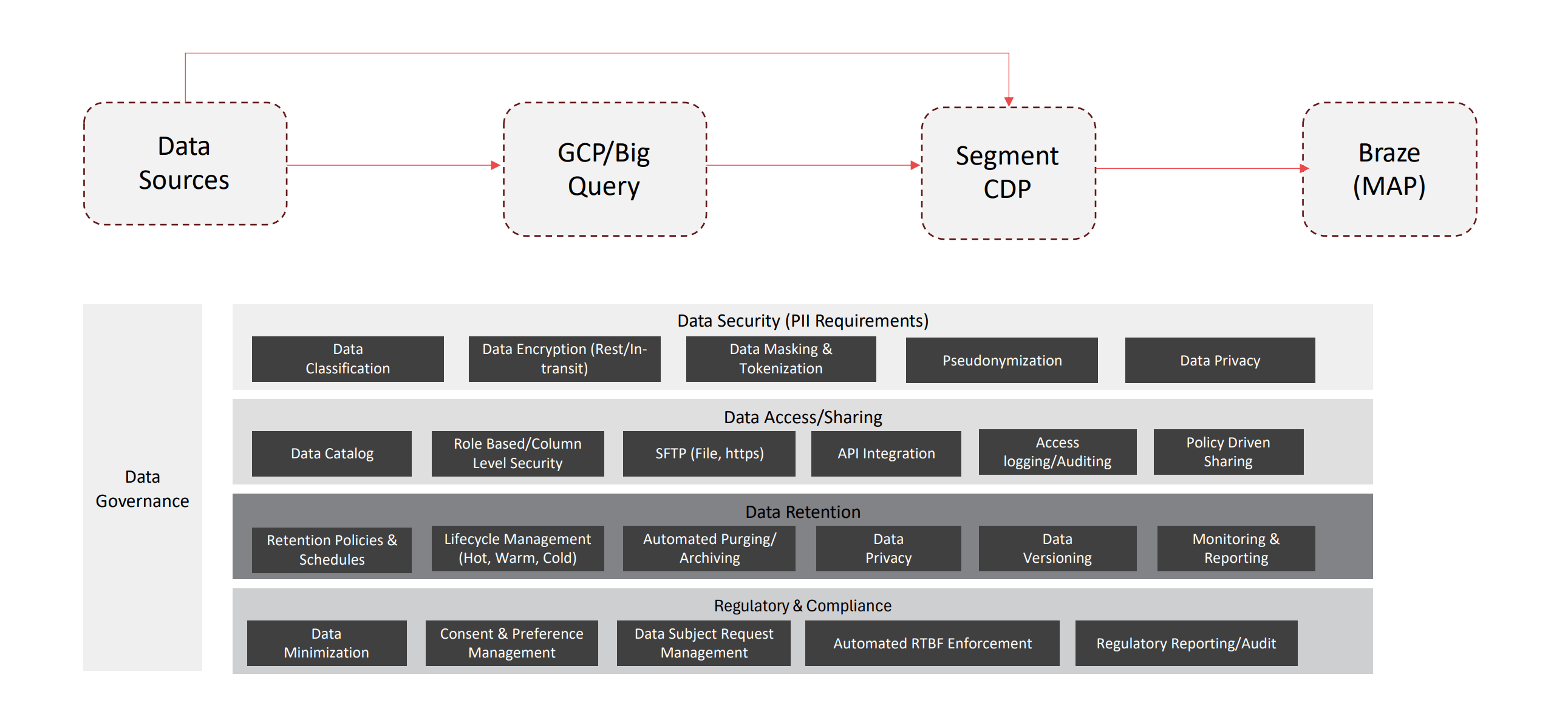
Four pillars support this journey:
- Data Security: Classification tags enforce policies. Encryption protects data at rest and in transit. Masking and tokenization shield PII based on user roles. Privacy by design guides every decision.
- Data Access & Sharing: A central catalog tracks lineage and ownership. Role-based controls limit access. Secure protocols handle transfers. Every API call gets authenticated and logged.
- Data Retention: Documented policies govern all data. Automated lifecycle transitions move data between storage tiers. Purging happens on schedule with appropriate safeguards for legal holds.
- Regulatory & Compliance: Regular reviews ensure data minimization. Consent management stays centralized. Data subject requests follow automated workflows. Cross-border transfers remain controlled.
Data Security Requirements
Protection starts with identification. We tag all PII fields consistently across systems. Names, emails, phone numbers, billing information—all receive appropriate classification.
Access follows the principle of least privilege. Role-based controls restrict who sees what. Column-level security in BigQuery and profile visibility limits in marketing platforms ensure sensitive data stays protected.
Encryption happens everywhere. We use AES-256 at rest and TLS 1.2+ in transit. Nothing moves unprotected.
Downloads require authorization. We restrict exports to approved roles only, using secure methods like signed URLs. This prevents data from walking out the door.
Next Steps
In our next article, we’ll explore data access controls, sharing protocols, and retention policies that keep your information both useful and compliant.
Remember: Strong governance doesn’t restrict business—it enables it. By establishing clear rules and automated enforcement, you free your teams to innovate without fear.